# Introduction
Over three years of mentoring data science students across more than a thousand sessions, one question comes up before anyone writes a line of code: where do I start with AI? Students arrive motivated but without a map. They read about machine learning engineers, research scientists, and data scientists, and assume…
import os, sys, io, json, time, math, re, subprocess, warnings
from collections import Counter, defaultdict
warnings.filterwarnings("ignore")
os.environ.setdefault("USE_TORCH", "1")
def _pip(*pkgs):
subprocess.run([sys.executable, "-m", "pip", "install", "-q", *pkgs], check=False)
try:
import doctr
except ImportError:
print(">> Installing python-doctr (this takes ~1-2 min on Colab)...")
_pip("python-doctr[viz]")
try:
import reportlab
except ImportError:
_pip("reportlab")
import numpy as np
import…
3.5 Flash: agentic tasks at scale This balance of speed and performance makes 3.5 Flash ideal for tackling long-horizon agentic tasks. What used to take a developer days or an auditor weeks, 3.5 Flash can now help complete in a fraction of the time, often at less than half the cost of other frontier models.…
In simple terms, retrieval-augmented fine-tuning, or RAFT, is an advanced AI technique in which retrieval-augmented generation is joined with fine-tuning to enhance generative responses from a large language model for specific applications in that particular domain. It allows the large language models to provide more accurate, contextually relevant, and robust results, especially for targeted sectors…
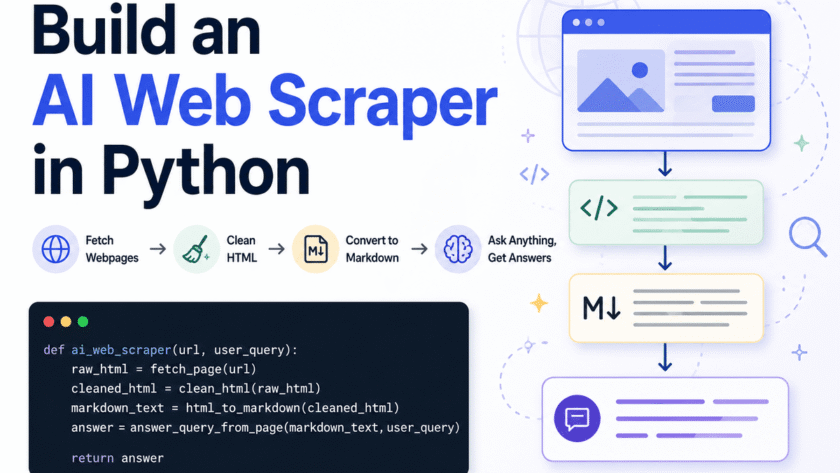
Web scraping is the process of collecting information from websites automatically. A normal scraper usually extracts raw text, HTML elements, or the full page content. But when you are building AI agents or large language model (LLM) applications, sending the entire webpage to the model is not always the best approach.
A better…
Yesterday, Liquid AI released LFM2.5-VL-3B. It is a 3.1B-parameter vision-language model built for on-device deployment. The model reads digital screens across mobile, web, and desktop. It grounds objects to coordinates, parses documents and charts, and calls tools from text or image input. Liquid AI reports an average of 69.4 across 28 vision benchmarks. That matches…
3.7 Flash shows strong gains over 3.6 Flash in coding tasks like debugging and issue resolution. It also achieves higher first-pass code accuracy and has improved performance in generating production-ready code as seen in FrontierCode 1.1 Main (43.6% vs 34.4%) and DeepSWE v1.1 (65.3% vs 49.0%). In web development, 3.7 Flash generates more functional layouts…
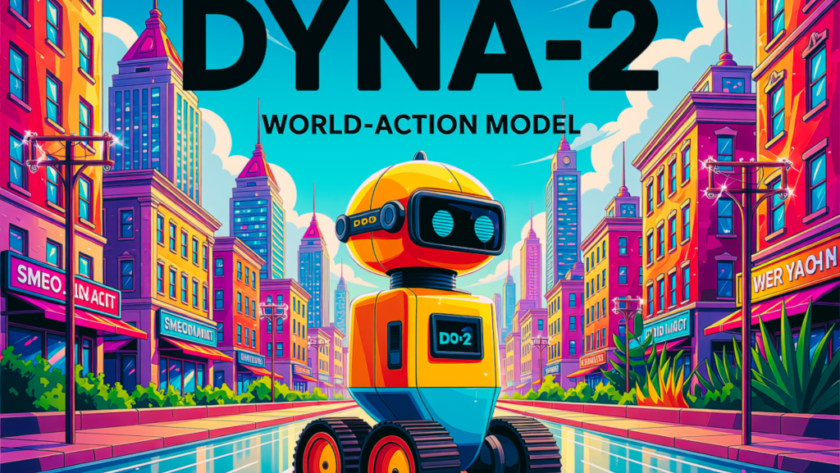
Dyna Robotics has released Dyna-2, a world-action model for robot manipulation. It was pre-trained on more than one million hours of egocentric human video. That is roughly 170 years of continuous waking experience. Robot learning has been bottlenecked by action-labelled data, which teleoperation must deliberately produce. Dyna-2 tests whether ordinary human video can substitute. The…
For years, this has been where you’ve found us — through Medium, whenever we published something worth your time. That’s changing a little, starting now. We’re expanding into a proper newsletter, so expect to hear from us more regularly than “whenever a new post goes up.” If you’ve got email notifications on for this publication, keep an eye on…
"Agent" might be the most overloaded word in AI right now. To one person it means a chatbot with a system prompt. To another, a script that calls an API twice. To a vendor's slide deck, it means a fully autonomous system that books your travel and negotiates your invoices. That gap between the…